
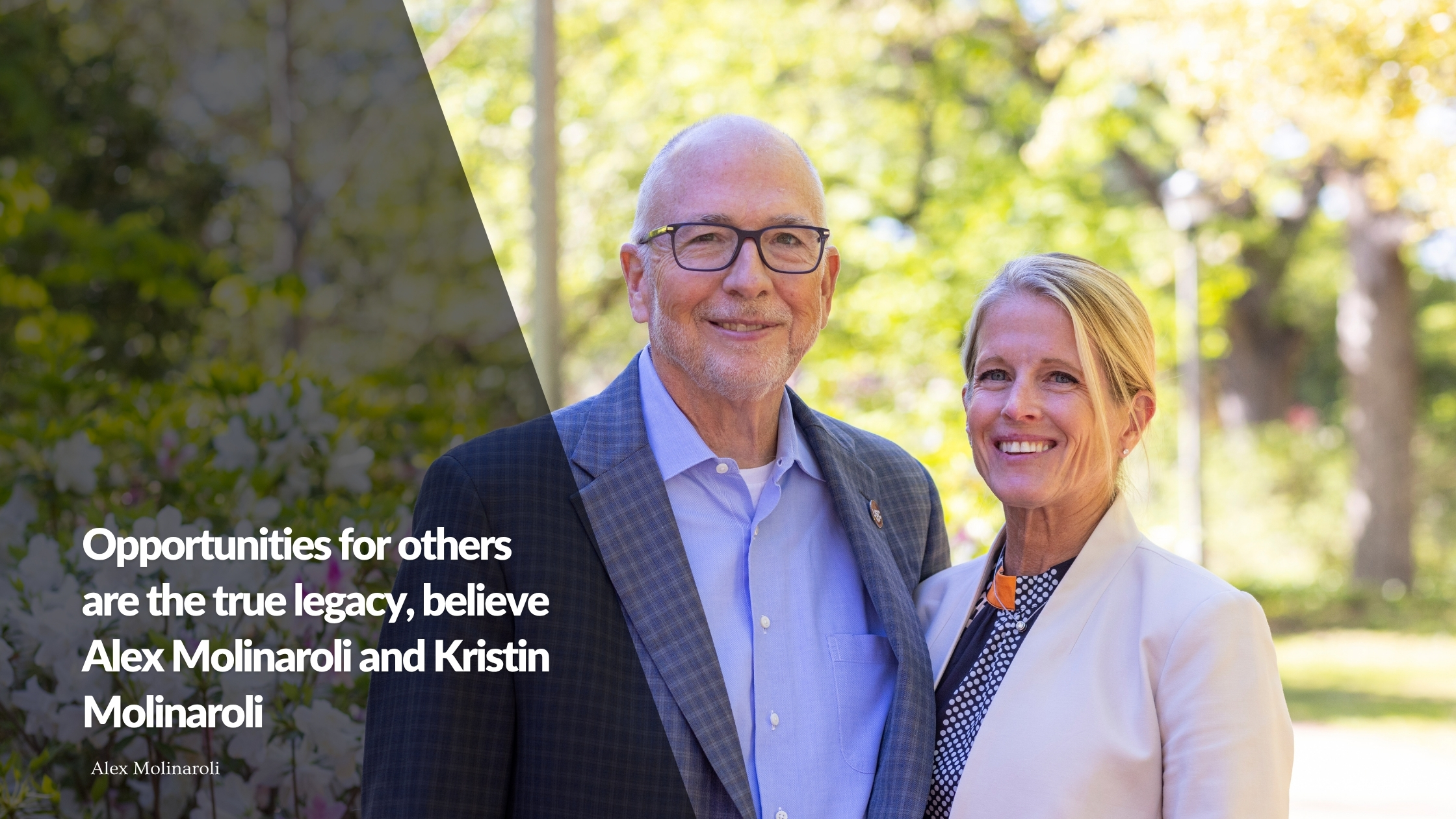
Success stories are often told from the vantage point of hindsight. There is a lot of justification for decisions taken, breakthroughs achieved, and moments of public recognition, but little reflection on the foundation on which the success was built – the years before those milestones, the sacrifices, the uncertainties, the opportunities that laid the groundwork before. For Alex and Kristin Molinaroli, understanding the opportunity they got as family legacy is the only way to look back at their success before looking forward.
Long before Alex Molinaroli became CEO of Johnson Controls, before he led one of America’s most respected industrial companies through a period of significant transformation, there was a family story unfolding that would shape how he thought about education, achievement, and responsibility for the rest of his life. It is a story that begins not with success, but with opportunity. Today, as the Molinarolis devote increasing attention to education and long-term institutional development, their work reflects a belief that has become central to their worldview: opportunities capable of changing lives rarely appear by accident. They are usually created by families willing to sacrifice, institutions willing to invest, and individuals willing to work hard when opportunity arrives.
Looking back at their own family history has only strengthened that conviction. When Alex Molinaroli speaks about opportunity, he often begins with his father. Not because family history is nostalgic, but because it provides perspective. “My father’s education allowed us to have a life that would not be possible without his education and hard work. His family sacrificed so he could have a great education and career. His accomplishment far outweighs anything I accomplished – I was only standing on his shoulders,” he says. There is a humility embedded in this statement that reveals something important about how the Molinarolis think about success.
Modern culture often celebrates self-made narratives. Yet many people who achieve significant success eventually recognize a more complicated truth. Individual accomplishment is rarely entirely individual. There are teachers, mentors, institutions, parents, communities, and opportunities that quietly shape outcomes long before achievement becomes visible. For the Molinarolis, family history serves as a constant reminder that success is often inherited not financially, but through opportunity. And opportunity itself is rarely guaranteed.
One of the most interesting shifts in many successful careers occurs when achievement begins to feel less like an endpoint and more like a responsibility. For Alex, that realization emerged gradually. “As your career progresses, you realize personal success is always because someone is helping you along the way,” he says. That does not diminish the importance of hard work. “Of course, you have to do the work, but you need to be open to help and support,” he explains. Over time, this changes how people think about leadership and accomplishment. The most influential mentors rarely view helping others as charity. They understand that talent grows when opportunity exists. They understand that development is not a zero-sum game. “These role models show you that helping others will help them, help the work get done, and ultimately come back to you in your own success and, most importantly, fulfilment,” he says.
Professional success often answers questions about capability. Fulfilment often answers questions about purpose. For many leaders, purpose increasingly becomes tied to helping create opportunities for others, particularly when they recognize how many people contributed to their own journey. The Molinarolis appear to have arrived at a similar conclusion. Their work today reflects a belief that success gains deeper meaning when it contributes to opportunities that extend beyond oneself.
Family has also shaped how Alex and Kristin understand the changing nature of opportunity itself. As parents, they have witnessed firsthand how different the world looks through younger eyes. “I have two daughters. As they grew and became part of the workforce, I began to see the world through their eyes – opportunities, frustrations, successes, failures and barriers. This perspective helped me relate to the younger generation and develop empathy for their perspective and what they face in the workforce today,” Alex says.
Every generation encounters its own challenges. But today’s students and young professionals are entering a world characterized by technological disruption, economic uncertainty, rising educational costs, and rapidly changing career expectations. Opportunities have increased as more pathways are available now than ever before. Yet navigating those pathways has become increasingly complex.
Parents often witness these realities differently than business leaders or policymakers. They see the emotional side of ambition. They observe uncertainty, pressure, setbacks, and resilience in real time. For the Molinarolis, these observations appear to have reinforced the importance of institutions capable of helping young people navigate that complexity, because while talent matters, opportunity structures matter too. And those structures do not maintain themselves.
Discussions about philanthropy often focus on generosity. The language tends to emphasize giving back, charitable support, and social responsibility. The Molinarolis do not reject that framing. But they also view the issue through another lens. “Philanthropy is giving back,” Alex says. Yet when it comes to education, he sees something more. “For me, investing in education provides a clear and mostly obvious path to a payback,” he says. The return, however, is not personal. It belongs to students, families, communities, and future generations. “Jobs, economic development, economic growth, personal wealth, and opportunity for the student,” he says. This perspective reflects a broader philosophy about how lasting change occurs. Individual acts of generosity can help individuals, but strong institutions can help entire populations.
Universities educate thousands of students. Educational systems shape regional workforces. Research institutions drive innovation. Workforce pipelines influence economic growth. The scale is fundamentally different. “The data and correlation are clear. Education is the single best determinant of personal success, jobs, and personal wealth creation,” he reasons. Perhaps the most powerful aspect of the Molinarolis’ philosophy is its simplicity. They do not speak primarily about legacy but continuity. The opportunities that changed one family can help change another. The support that benefited one generation can benefit the next. The institutions that opened doors decades ago can continue opening doors if they remain strong.
When asked what they hope future students might carry forward from opportunities being created today by them, Alex says, “If they see the impact and appreciate the support, hopefully they will see within themselves the opportunity to ‘pay it forward’ when the opportunity presents itself.”
Paying it forward is often described as an act of generosity. But in the Molinarolis’ worldview, it is also an act of gratitude. It begins with recognizing that success is rarely achieved alone. It continues with the understanding that institutions matter because they create opportunities at scale. And it endures when those who benefit from opportunity choose to help extend it to others.
In the end, the story of Alex and Kristin Molinaroli is not primarily about philanthropy, business leadership, or even education. It is about how people interpret their own experiences. Some look at success and see achievement. Others look at success and see responsibility.