
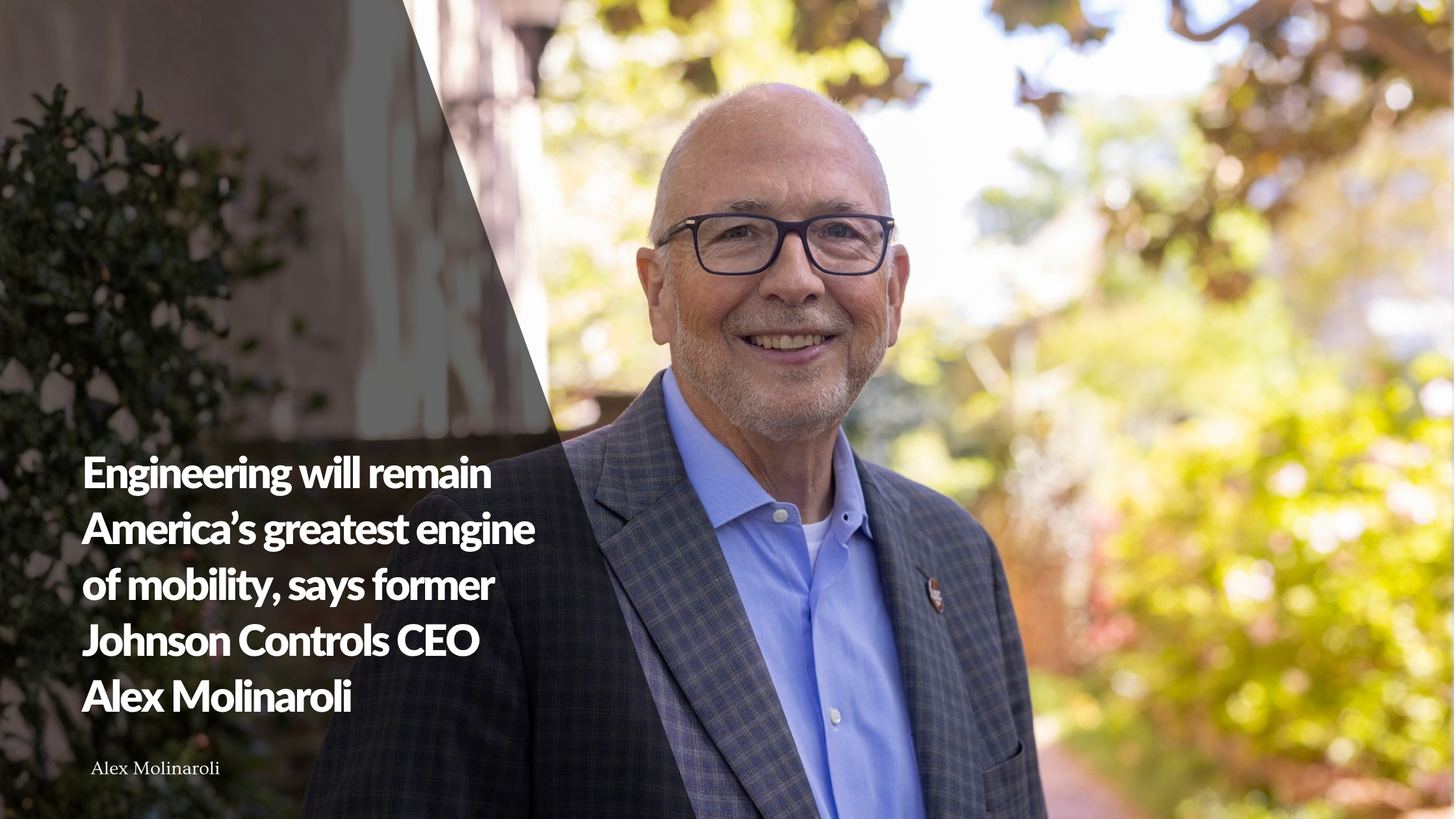
In an era dominated by conversations about artificial intelligence and workforce disruption, it is generally being said that engineers will be the first casualty, even though they create opportunities for the future. With almost daily reports of job cuts and new AI-driven ventures offering cost savings by way of automation, many say the landscape actually looks bleak for engineers, but for Alex Molinaroli, former CEO of Johnson Controls, it is not the beginning of their end, but the beginning of unleashing their true potential.
Long before Alex Molinaroli led a global industrial company, engineering education had changed the trajectory of his career and family, transforming distant opportunities into something tangible. It provided a path from economic uncertainty to stability, and from stability to prosperity. And that is what he sees engineers doing even in the post-AI era. “My father provided his children with a wonderful middle-class life because he received an engineering degree,” Alex reflects. “It definitely moved our family from a generation of poverty.” The impact did not stop there. “Likewise, my engineering education provided me a foundation to build upon that success and achieve success I could only dream of as a child.”
For Alex, engineering has never been merely a profession. It is a platform for opportunity. And at a moment when America is searching for ways to strengthen economic mobility, workforce competitiveness, and long-term prosperity, he believes engineering remains one of the country’s most underappreciated engines of advancement. Much of today’s public debate about economic mobility focuses on financial support, government programs, or technological disruption. But Alex believes they sometimes overlook something more fundamental: the transformative power of education that equips people not only with knowledge, but with the ability to solve problems.
An engineering degree certainly provides technical expertise. Yet Alex argues that the most valuable lessons often extend beyond technical knowledge itself. “Of course, an engineering degree teaches hard and applied science and provides technical expertise, but more importantly, the rigors of the coursework teach you to solve problems, think critically, plan, work under pressure, and work within teams,” he says. Industries change, technologies evolve, entire business models disappear and re-emerge, but an engineer’s ability to approach complexity methodically, work through uncertainty, and solve difficult problems remains valuable regardless of any disruption, he reasons.
One reason Alex remains passionate about engineering education is that his understanding of its value has expanded over time. As a young engineer, he saw engineering primarily as a technical discipline. As an executive, he saw it as a leadership foundation. Today, through his involvement in education and workforce development, he views it as something even broader. “My perspective has changed – an engineering degree can allow the opportunity to solve some of the great known and future problems. It also proves to yourself and others that you have the desire and curiosity to learn and grow. It’s a great foundational step regardless of what career path you take…technical, business, leadership, medical, legal, etc.,” he says. This observation reflects a reality often overlooked in discussions about education. Employers are not simply evaluating what students know. They are evaluating how they think, how they learn, and how they adapt. Engineering develops habits of mind that can be applied across an extraordinary range of careers. “It’s a great foundational step regardless of what career path you take, be it technical, business, leadership, medical, legal, or any other,” he says.
In that sense, engineering functions less like vocational training and more like intellectual infrastructure, he claims. “It equips individuals with tools they can use repeatedly as industries evolve and opportunities emerge.” The relevance of engineering becomes even more interesting in an age increasingly defined by artificial intelligence. Many students entering universities today will graduate into workplaces dramatically different from those their parents experienced. AI systems are beginning to automate tasks once considered highly specialized. Knowledge that once required years of study can increasingly be accessed instantly. This raises an important question: What skills will matter most when information itself becomes abundant? Alex believes future engineers will need a different balance of capabilities than previous generations.
“A deep technical set of skills will become commoditized – AI will replace many of these knowledge-based skills. But the ability to think critically and solve problems (using these new tools) will be increasingly important. Managing the work, directing the work, identifying the problems vs doing the work will become invaluable,” he says. Alex sees it as a reason to strengthen engineering education rather than diminish it. “The ability to think critically and solve problems using these new tools will be increasingly important,” he says. In other words, the future belongs less to those who simply possess information and more to those who can apply judgment, he adds.
“Managing the work, directing the work, identifying the problems versus doing the work will become invaluable,” Molinaroli says. The competitive advantage for engineers, he believes, is no longer merely technical expertise. It is the ability to integrate technology, human judgment, systems thinking, and leadership into coherent solutions. If engineering remains one of America’s most powerful engines of mobility, then universities remain among the institutions most responsible for keeping that engine running. Yet Alex believes higher education faces an urgent challenge. Too many institutions, he argues, continue teaching in ways designed for previous generations rather than future ones. His advice is direct. “Embrace the new technologies. Adapt new curriculum.”
That sounds obvious, but institutional change is often difficult. “Don’t continue to do things the way you did because that’s how you were taught,” he says, “or because that’s the way it always has been.” The pace of technological change is accelerating. Artificial intelligence, advanced manufacturing, energy transition, infrastructure modernization, and digital systems are reshaping industries simultaneously. The goal is not simply employability, but adaptability, because the careers students enter today may look very different five, ten, or twenty years from now, he says.
Alex ultimately views engineering education through a lens larger than individual success, as talent development is also a question of national competitiveness. Countries that cultivate technical talent, foster innovation, and prepare future problem-solvers will be better positioned to navigate economic change, he says, reasoning that regions that build strong engineering pipelines will attract investment, create jobs, and generate long-term prosperity.
“If educational systems fail to evolve, talent shortages will grow. Innovation capacity will weaken. Economic opportunity will become increasingly uneven. Engineering, in this sense, is part of a nation’s infrastructure. Just as roads move goods and power grids move electricity, educational institutions move human potential. They create the talent pipelines that support industries, strengthen communities, and enable future growth,” he says.
At a moment when America is striving to retain its supremacy, Alex believes engineering and technical education will remain at the forefront of this effort, because while technologies will change and industries will evolve, the ability to solve meaningful problems remains one of the most valuable forms of capital a society can create. And few educational pathways have done more to cultivate that capability than engineering.