
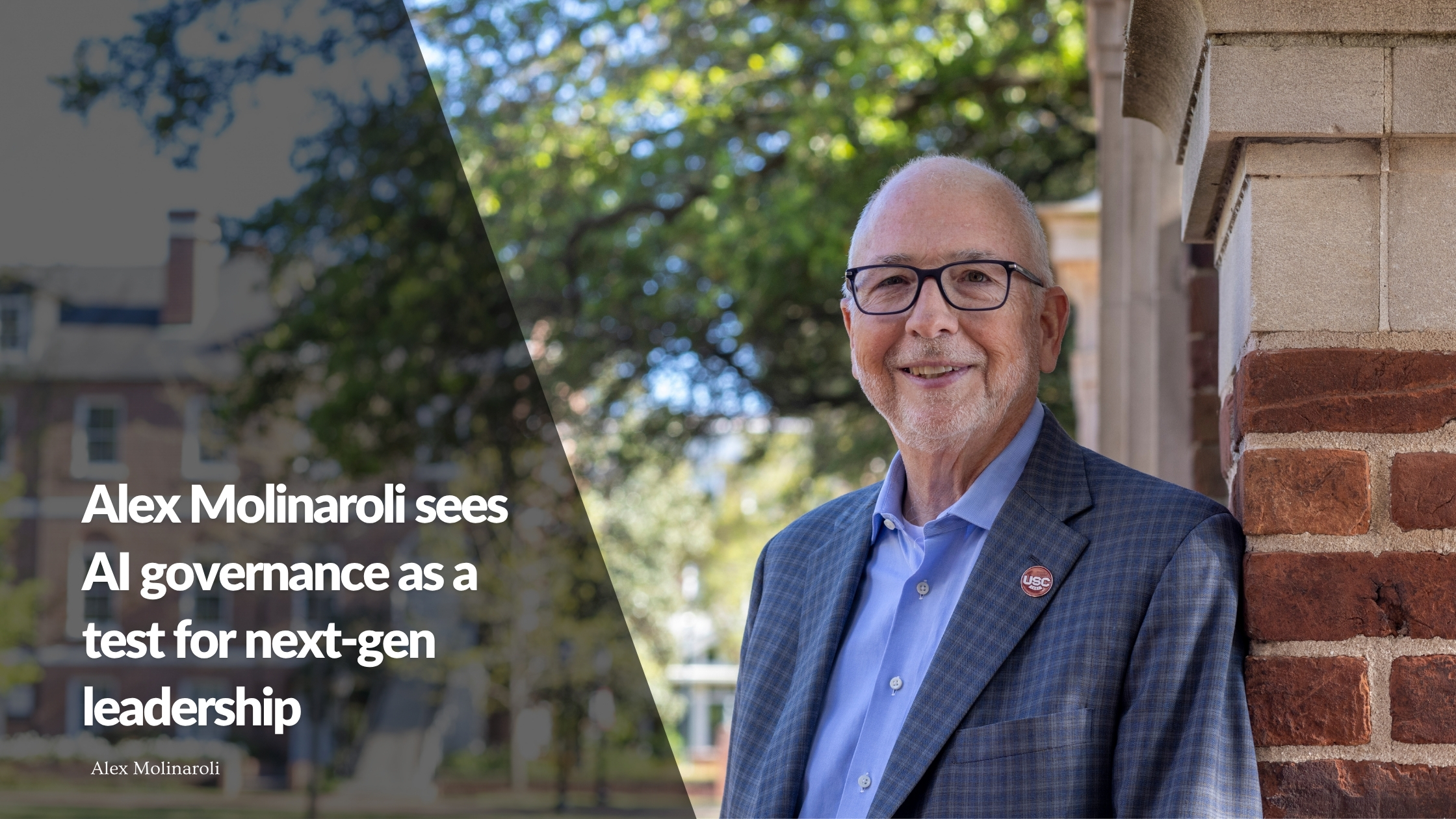
Organizations worldwide are accelerating AI adoption at a remarkable speed. New systems are being integrated into operations, workflows are being automated, customer interactions are increasingly becoming algorithmic, and decision-making is becoming faster, cheaper, and more scalable. On the surface, the transformation appears overwhelmingly positive, but beneath the momentum, something more profound is happening. Artificial intelligence is no longer functioning solely as a support tool but is beginning to shape decisions, influence priorities, and increasingly participate in operational execution itself. Alex Molinaroli, former CEO of Johnson Controls, believes this also marks a change in the role of leadership. He believes the defining challenge is no longer whether organizations can adopt AI, but whether they can govern it.
In Molinaroli’s view, organisations are moving far faster in building AI capabilities than in building the institutional structures necessary to oversee their responsibilities. “Most organizations today are grappling with their AI strategy. They have little idea how AI will fundamentally redefine their business, products, cost structure, internal processes, or even business models, and how it will bring new competition. Organizations will anyway rush to adopt the technology as a tool, but only a top-down driven strategy will allow them the willingness to actually refine what they do and how they do it,” he reasons.
Much of the current AI conversation is framed around capability – what systems can do, how quickly they improve, and how broadly they can be deployed. But capability and readiness are not the same thing, he says, arguing that organizations often mistake access to AI tools for organizational preparedness. “Deploying AI across workflows can create the appearance of modernization while leaving deeper governance questions unresolved. And yet, many organizations continue approaching AI primarily as a technical implementation challenge,” he says.
Molinaroli believes true AI transformation is not about layering technology onto existing systems. It is about redesigning institutional behavior itself. In its early stages, AI adoption often feels manageable because the technology remains peripheral. It assists employees, improves efficiency, and accelerates analysis without fundamentally changing organizational authority structures. But there is a threshold after which AI ceases to be merely supportive. “At what point does AI move from being a support tool to something that materially influences decisions?” Molinaroli repeats thoughtfully. “Only once AI becomes core to a company’s processes,” he says. A support tool can be monitored through existing management systems. But once AI becomes embedded inside operational decision-making, the organization itself begins to change shape.
“This will be easier for young companies to adopt,” he says, “and incredibly difficult for legacy organizations.” Young companies often build around AI from inception. Their systems, culture, and processes evolve together. Legacy organizations, however, face a more difficult reality of integrating AI into structures that were never designed for algorithmic decision-making. As AI moves deeper into procurement, hiring, logistics, forecasting, customer service, compliance, finance, and strategic analysis, accountability will begin to diffuse across systems rather than individuals. But this is where leadership models begin to strain.
Traditional organizations were designed around identifiable responsibility. Decisions were made by individuals or teams operating within visible reporting structures. AI complicates this architecture. When outcomes are influenced by algorithms, predictive systems, automated recommendations, or machine-generated analysis, responsibility becomes harder to locate. And many organizations are currently underestimating how destabilizing unclear accountability can become over time.
“How should accountability be defined when outcomes are shaped by AI systems?” Molinaroli asks. His answer is direct: “Accountability for outcomes will be important. Compliance and process measurements will not be enough.”
Many organizations currently focus AI governance around procedural compliance: whether systems follow approved frameworks, whether documentation exists, and whether regulatory standards are met. But process compliance alone does not guarantee responsible outcomes.
A perfectly compliant system can still produce harmful, distorted, biased, or strategically damaging results. Which means the next generation of leadership will increasingly be judged not by whether organizations followed process, but whether leaders maintained ownership over outcomes.
One of the most dangerous misconceptions surrounding AI adoption is the belief that governance can emerge organically from implementation itself. Molinaroli strongly rejects this assumption. “Only the Board and the company’s executives can properly oversee the execution. Otherwise, organisations will only see the costs for AI adoption and not the benefits. This needs to be a top-down driven implementation,” he says.
The reasoning is straightforward: AI adoption affects incentives, organizational structures, operational authority, cost structures, and strategic direction simultaneously. No isolated department possesses the institutional visibility to manage those interactions comprehensively. Without executive oversight, organizations often experience a predictable failure pattern, he says, adding that senior executives should not micromanage technical systems, but they can align AI deployment with organizational purpose, risk tolerance, and long-term strategic direction.
Much of the public conversation around AI focuses on the capabilities of the technology itself. But Molinaroli’s perspective shifts attention toward something more fundamental: incentives.
“Technology rarely behaves independently of the systems surrounding it. Organizations shape outcomes through what they reward, prioritize, and measure,” Molinaroli says.
If he were to advise a CEO, Molinaroli says, his priority would be on setting governance structures before scaling AI across the organization. “Everything needs to be driven by the outcomes expected. Better outcomes (more, cheaper, better, etc.). Of course, new processes and systems will be created, but this should be an outcome-driven change,” he says. The reason being, he says, technology does not create institutional behavior independently. Leadership does.